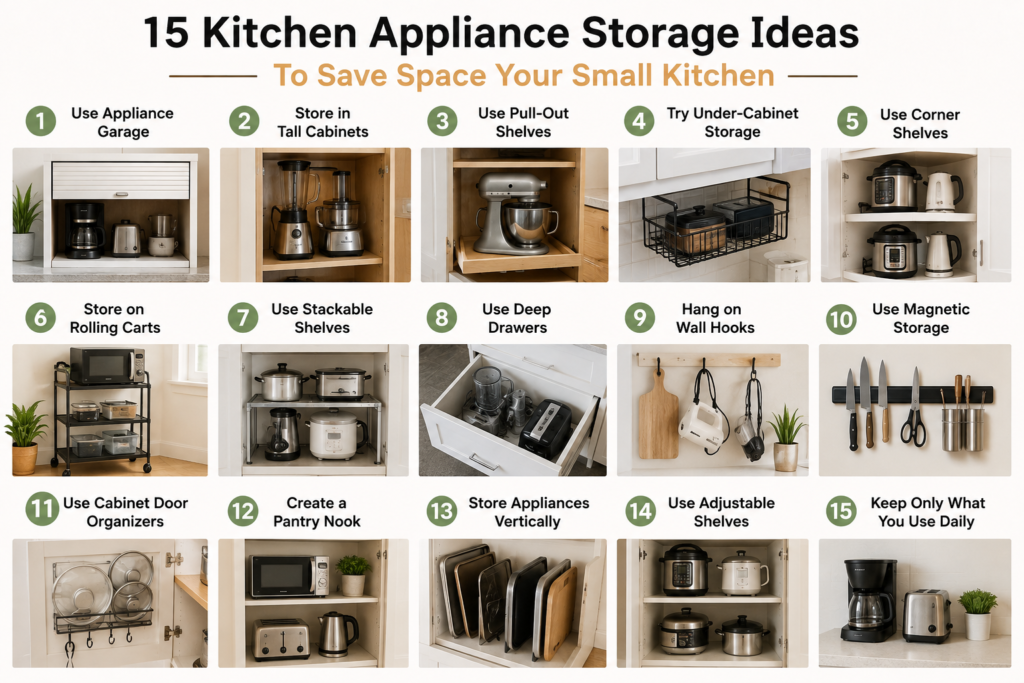
Small appliances can make cooking much easier everyday, but they can also take over most kitchen space. Air fryers, blenders, toasters, coffee makers, mixers, rice cookers and many other appliances often end up competing for limited countertop and cabinet space.
Hiding everything away is not necessarily the solution. A better approach is to create a systematic storage based on how often you use these appliances, how much space it needs, how heavy it is and how easily you need to access it.
On the basis of my everyday problem these small kitchen appliance storage ideas can help you reduce counter clutter while keeping frequently used appliances convenient. Whether you live in an apartment, a compact urban kitchen, a rental home or a larger house with limited cabinet space, the goal is the same: give every appliance a practical place without making the kitchen harder to use.
The best solution will depend on your kitchen layout, cabinet construction and appliance collection.
1. Create a Dedicated Appliance Zone
Instead of spreading appliances throughout the kitchen it is better to assign one cabinet, pantry section or storage area to them.
Group appliances that are used for similar tasks, such as coffee-making equipment together or baking appliances in one area. This makes it easier to find your needs and prevents appliances from being randomly placed wherever space happens to be available.
For a small kitchen, even one dedicated cabinet shelf can make a noticeable difference.
2. Use Vertical Cabinet Space
Many cabinet spaces have unused above stored appliances. Adjustable shelves and stackable organizers can turn some of this unused vertical area into additional storage levels.
This works particularly well for smaller appliances and accessories, provided the shelf and organizer can safely support their weight.
Before buying an organizer, measure the cabinet’s internal width, depth and usable height rather than relying only on external cabinet measurements.
3. Store Frequently Used Appliances Near the Work Area
Storage should make your kitchen easier to use, not create extra work.
If you use a toaster, coffee maker or blender almost every day, storing it at the far end of a pantry may encourage you to leave it permanently on the counter.
Keep frequently used appliances in an easily accessible cabinet or designated countertop area. Less frequently used appliances can take the harder-to-reach storage positions.
4. Consider Pull-Out Shelves
It’s difficult to use deep cabinets because appliances at the back become difficult to reach and pull-out shelves can bring stored items forward.
This can be particularly useful for heavier appliances that would otherwise require you to reach deep into a cabinet.
Before installation, check the cabinet construction, available clearance and the shelf’s weight capacity. The appliance should remain stable when the shelf is extended.
5. Add Appliance Shelves Inside Cabinets
Appliance shelves can separate items such as a blender, toaster or food processor from accessories stored underneath and these shelves are created without requiring a major kitchen renovation.
Look for sturdy construction and dimensions that suit your cabinet. Avoid overcrowding the shelf simply because an additional level has been created.
6.Make Corner Space for Better Use
Kitchen corners often become difficult storage areas. Instead of allowing them to become dead zones, consider whether a corner cabinet organizer, shelf or suitable storage unit could make the space more accessible.
Corners are often better suited to appliances or accessories that are used occasionally rather than items you need several times a day.
7. Create an Appliance Garage
An appliance garage is a dedicated cabinet or enclosed section designed to keep countertop appliances accessible while reducing visual clutter.
It can work well for appliances you use regularly but do not necessarily want to be visible all the time.
When planning this type of storage, make sure the space is appropriately sized and that appliances are stored according to their manufacturer’s instructions. Appliances should be cool and dry before being put away.
8. Use Open Shelving Carefully
Open shelves can make appliances easy to access, but they can also make a small kitchen look crowded.
Use open shelving selectively. A neatly arranged toaster, coffee maker or attractive appliance may work well, while several bulky appliances can quickly create visual clutter.
Group similar items and leave enough space between them to make the shelving practical rather than simply filling every available area.
9. Keep Everyday Appliances on the Countertop
Not every appliance needs to disappear into a cabinet.
If you use an appliance every day, leaving it in a designated countertop position may actually be the most efficient solution.
The key is to be selective. Instead of keeping every appliance visible, choose the few that genuinely earn their countertop space and store the rest.
10. Store Rarely Used Appliances Elsewhere
Seasonal and occasional appliances do not necessarily need prime kitchen storage.
Items used only occasionally can be stored in a suitable pantry, utility cupboard or other dry storage area if the location is appropriate.
This frees your most accessible kitchen cabinets for appliances and cookware you use regularly.
11. Use Stackable Storage Solutions
Stackable shelves can create additional levels inside cabinets without requiring permanent changes.
They are particularly useful for smaller appliances, containers and accessories.
However, stacking should not make heavy appliances difficult to remove. If you have to lift a heavy appliance over another item every time you use it, the arrangement may save space while making the kitchen less convenient.
12. Use the Space Under Cabinets Carefully
Under-cabinet space can sometimes be useful for lightweight organization solutions, but it should not be treated as unlimited storage.
Choose products specifically designed for the intended application and follow their installation instructions. Avoid placing items where they interfere with cooking, ventilation, electrical connections or normal food-preparation activities.
The aim is to reclaim otherwise unused space without creating a safety or accessibility problem.
13. Organize Appliance Accessories
An appliance is easier to store when its accessories have a designated home.
Keep blender attachments, mixer accessories, food-processor parts, cords and other removable components together where practical.
Small storage bins, cable organizers and labeled containers can help prevent accessories from becoming scattered throughout different cabinets.
For sharp attachments or blades, use appropriate protective storage and handle them carefully.
14. Choose Renter-Friendly Storage Solutions
If you rent your home, you may not want permanent cabinet modifications.
Freestanding shelves, removable organizers, stackable racks and storage carts can provide additional organization without requiring major changes to the kitchen.
Always check the dimensions and stability of removable products before use. A solution that does not fit properly can create more clutter instead of reducing it.
15. Create a “One Appliance, One Zone” System
Give each appliance a consistent storage location.
For example, the blender might always return to one cabinet shelf, while the toaster occupies a designated countertop area and baking appliances stay together.
This simple system makes tidying easier because you do not have to decide where something belongs every time you put it away.
Over time, consistent storage can be more effective than constantly searching for new ways to create additional space.
Useful Products for Small Kitchen Appliance Storage
The right storage product depends on the problem you are trying to solve. Rather than buying organizers simply because they look useful, measure your space first and identify what is making your kitchen difficult to organize.
| Storage product type | What it does | Suitable for | What to check | Potential advantage | Possible drawback |
| Adjustable cabinet shelves | Creates additional storage levels | Cabinets with unused vertical space | Width, height and weight capacity | Makes better use of vertical space | Can reduce clearance |
| Pull-out cabinet organizers | Brings stored items forward | Deep cabinets | Cabinet construction and load capacity | Easier access | May require installation |
| Appliance shelves | Separates appliances into levels | Small appliances and accessories | Dimensions and stability | Improves cabinet organization | Not ideal for very heavy appliances unless rated for them |
| Countertop organizers | Keeps selected appliances or accessories organized | Everyday kitchen items | Counter space and dimensions | Easy access | Can still contribute to visual clutter |
| Rolling carts | Adds flexible storage | Small kitchens and rentals | Stability, wheel quality and size | Can be moved when needed | Requires floor space |
| Stackable shelves | Adds vertical levels | Small appliances and accessories | Stability and load rating | Affordable way to use cabinet height | Poor stacking can make access difficult |
| Under-shelf baskets | Uses space beneath shelves | Lightweight accessories and small items | Shelf compatibility and load capacity | Uses otherwise unused space | Limited suitability for heavy appliances |
| Appliance storage cabinets | Provides dedicated appliance storage | Larger appliance collections | Internal dimensions and ventilation requirements | Keeps appliances together | Requires additional floor space |
| Cable organizers | Controls appliance cords | Appliances with removable or loose cables | Material and size | Reduces tangled accessories | Does not solve appliance storage by itself |
| Storage bins | Groups accessories and smaller components | Attachments, cords and parts | Size, material and accessibility | Keeps small parts together | Can become cluttered if not labeled |
If you are comparing products, focus on fit, weight capacity, accessibility and construction rather than simply choosing the product with the most features.
How to Choose the Right Appliance Storage Solution
Start by measuring the available space. Record the cabinet’s usable width, depth and height, then compare those measurements with the organizer or shelf you are considering.
Also consider:
- Appliance weight: Heavy appliances need appropriately rated shelves or storage.
- Appliance dimensions: Measure the appliance itself, including space needed to remove it comfortably.
- Frequency of use: Everyday appliances should be easier to access than occasional ones.
- Cabinet depth: Deep cabinets may benefit from pull-out storage.
- Accessibility: Avoid arrangements that require awkward lifting or reaching.
- Shelf strength: Check the stated load capacity where available.
- Material: Choose materials appropriate for the kitchen environment and expected use.
- Cleaning: Storage products should be practical to wipe or clean.
- Installation: Check whether installation requires tools or permanent modifications.
- Rental requirements: Freestanding and removable options may be more appropriate for rented homes.
A good storage solution should save space without making the appliance harder to use.
Common Small Kitchen Appliance Storage Mistakes
Even a well-organized kitchen can become cluttered when storage decisions are based only on available space.
Common mistakes include:
- Keeping every appliance permanently on the countertop.
- Storing frequently used appliances too far away.
- Ignoring unused vertical cabinet space.
- Overcrowding shelves and cabinets.
- Placing heavy appliances too high.
- Separating appliances from their important accessories.
- Buying organizers without measuring the available space.
- Choosing storage that makes appliances difficult to remove.
- Storing appliances before they have cooled appropriately.
- Ignoring manufacturer storage instructions.
Remember that electrical appliances should be kept dry, ventilation openings should not be blocked during operation, and appliances should be stored and handled according to their manufacturer’s instructions.
Frequently Asked Questions
1. How should I store small kitchen appliances?
Store appliances according to how frequently you use them. Keep everyday appliances in easily accessible locations and move occasional appliances into less valuable storage space. Use shelves, pull-out organizers or stackable solutions when they genuinely improve cabinet capacity. Always consider appliance weight, dimensions, stability and the manufacturer’s storage instructions.
2. How do I organize appliances in a small kitchen?
Start by grouping appliances into zones based on how you use them. Keep frequently used appliances near the main work area and use vertical cabinet space for smaller items. Store accessories together and avoid filling every available space. A simple system where each appliance has a consistent home can make a small kitchen easier to maintain.
3. How can I keep appliances off the kitchen counter?
Use dedicated cabinet shelves, pull-out storage, stackable organizers or a suitable storage cart. However, do not automatically hide appliances that you use several times a day. A practical approach is to keep only your most frequently used appliances on the counter and store everything else in accessible storage.
4. Where should rarely used kitchen appliances be stored?
Rarely used appliances can usually occupy less accessible storage areas, such as a suitable pantry, utility cupboard or higher cabinet, provided the location is dry, stable and appropriate for the appliance. Avoid storing heavy appliances where removing them requires unsafe lifting or awkward reaching.
5. What is the best storage solution for small kitchen appliances?
There is no single best solution for every kitchen. Adjustable shelves work well for unused vertical space, pull-out storage can help with deep cabinets, and rolling carts can add flexible storage. The best option is the one that fits your available space, appliance weight and usage habits while keeping the appliance accessible.
6. How can I organize kitchen appliances without remodeling?
Use removable or freestanding solutions such as stackable shelves, cabinet organizers, storage bins, rolling carts and countertop organizers. Start by measuring your existing cabinets and identifying wasted space. Rearranging appliances according to frequency of use can also create a noticeable improvement without making permanent changes.